
When smoke from a kretek, or clove cigarette, passes through a holder, some components can stick to the airway and form a dark deposit. The colour and amount of residue can’t tell you what percentage of tar the holder retains. Carbon monoxide and other components of smoke can still pass through.
- Smoke can cool as heat transfers to the holder’s walls.
- Deposits can form when particles stick or certain components condense.
- Measuring the percentage of tar retained requires comparing smoke samples under equivalent test conditions.
In this article
If you’ve ever cleaned a kretek cigarette holder, you may have seen a dark, sticky coating inside. Why does that coating build up while smoke still comes out of the mouthpiece? To understand how a cigarette holder works, start with what the smoke carries into the airway.
What does kretek smoke carry?
Cigarette smoke is a mixture of gases and aerosol. An aerosol consists of tiny particles or droplets suspended in a gas. These components can behave differently as they travel through a holder.
| Component | What can happen? |
|---|---|
| Gases such as carbon monoxide (CO) | The flow can carry CO all the way out through the mouthpiece. |
| Aerosol particles and droplets | Some may stick to the walls. Others travel on with the smoke. |
| Nicotine and water | Nicotine can occur in both the particle and gas phases. Some water vapour may condense if the temperature allows it. |
How smoke travels through a kretek cigarette holder
- Smoke enters from the cigarette. When someone draws on the mouthpiece, smoke from the cigarette enters the airway and moves towards the mouth.
- Heat transfers along the way. If the walls are cooler than the smoke, some heat can transfer to the holder. How much the temperature changes depends on the holder and the flow conditions.
- Some components stick. Droplets and particles that hit a surface may stay there. Components that condense can also contribute to the sticky coating. The rest continue towards the mouthpiece.
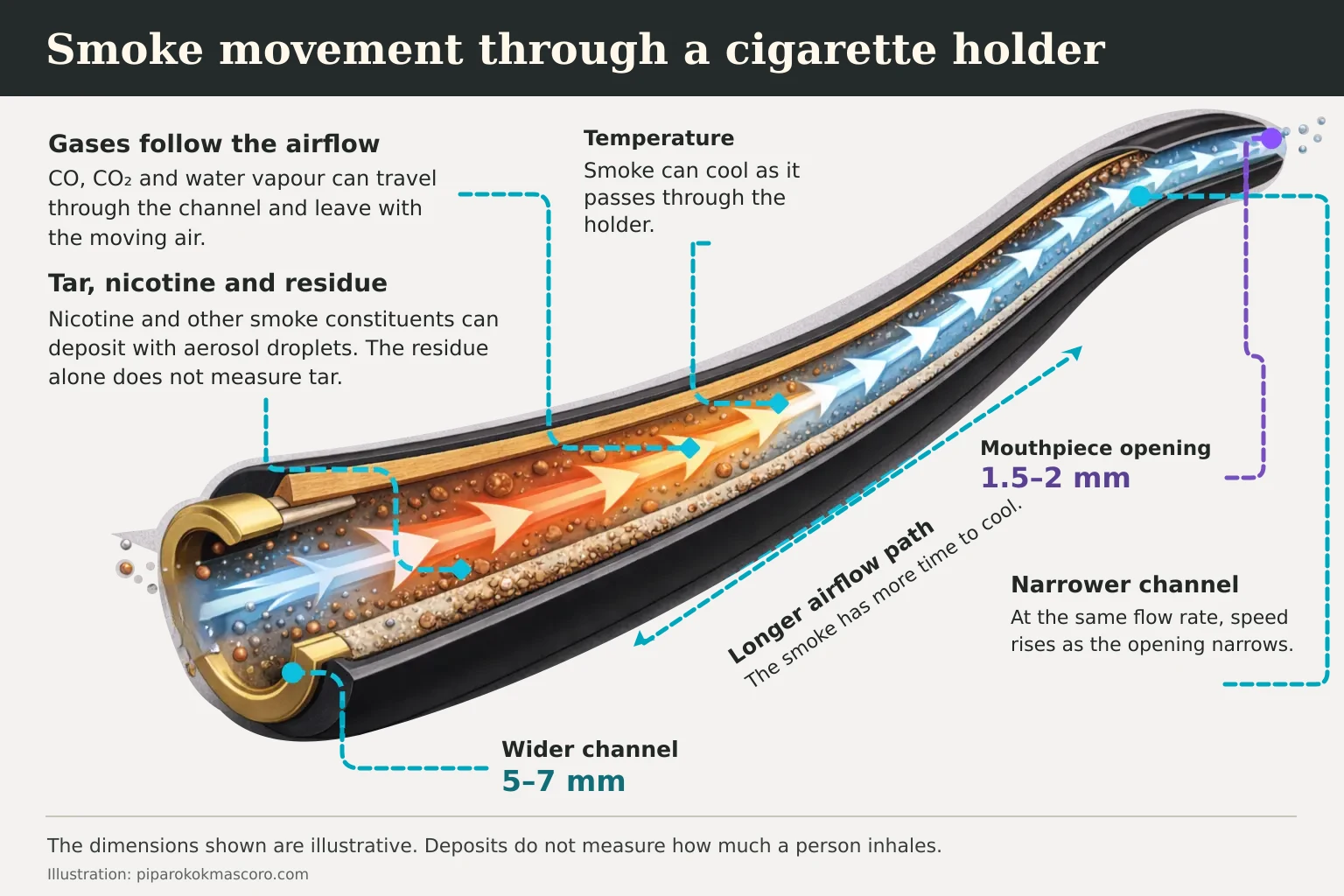
How do length, diameter and bends affect the flow?
A longer airway provides more surface area for heat transfer. The temperature at the mouthpiece also depends on the initial wall temperature, the material, the flow rate and how often the holder is used in succession. You can’t predict the final temperature from length alone.
A narrower airway can increase resistance to the draw. If the same volume of gas passes through each second, its average speed increases in the narrow section. In use, the flow rate itself can change. At a bend, some droplets may hit the wall because they change direction less readily than the gas. How much sticks depends on particle size and flow conditions.
If you’ve wondered why two holders made from the same material can feel different, see why smoke can feel hot through a wooden cigarette holder.
How much tar does a cigarette holder retain?
You can’t tell by looking at the coating on the wall. In the FDA analytical method, tar is calculated from the mass of smoke particulate matter collected, after subtracting the mass of water and nicotine. The coating you see inside a holder can contain several components, so its colour cannot give you a tar measurement.
To assess a particular model, researchers would need to compare the same type of kretek with and without the holder, use the same machine-puffing pattern and repeat the tests. The results would apply to those test conditions. Actual exposure also depends on how a person smokes and cannot be inferred from the deposit.
When should you clean the airway?
Fresh deposits can build up with use. Check the airway when the draw feels tight or a smell lingers. Let the holder cool and use a tool that fits the channel. How to use a cleaning liquid depends on the holder’s material and finish. For the full method, see our guide to cleaning a cigarette holder.
FAQFrequently asked questions
Can a kretek cigarette holder retain tar?
Some smoke components can stick and form deposits. To know how much tar a particular model retains, it needs to be tested under measured conditions.
Why does the inside turn black and sticky?
Particles and droplets from smoke can stick to the airway. Components that condense can add to the coating, which builds up with repeated use.
Does a narrower airway retain more tar?
Not necessarily. Narrowing the channel changes resistance and flow. The amount of material deposited also depends on the shape of the channel, the flow rate, the temperature and particle size.
Is smoke that feels cooler any safer?
The temperature you feel in your mouth does not measure how much harmful material you inhale. Cigarette smoke still contains harmful substances even when it feels cooler.

Kharisma Candra
Founder of Pipa Rokok Mascoro in Balung, Jember. Kharisma works with local craftspeople and writes about cigarette holders. About me (in Indonesian)
Sources
- FDA laboratory guidance on tobacco product analysis, including the measurement of tar, nicotine and carbon monoxide
- Pankow and colleagues, study of the forms of nicotine in cigarette smoke particulate matter (2003)
- National Cancer Institute explanation of the limits of machine measurements in estimating exposure
These references explain smoke analysis and general measurement principles. This article reports no test figures for a Mascoro cigarette holder.