
✦ Short answer
Avoid vaping in a shared air-conditioned room. Most wall-mounted air conditioners cool and recirculate the air already in the room. Someone sitting beside you can still breathe in the aerosol you exhale. In an Indonesian office or café, check the smoke-free rules and use a designated outdoor area if one is available.
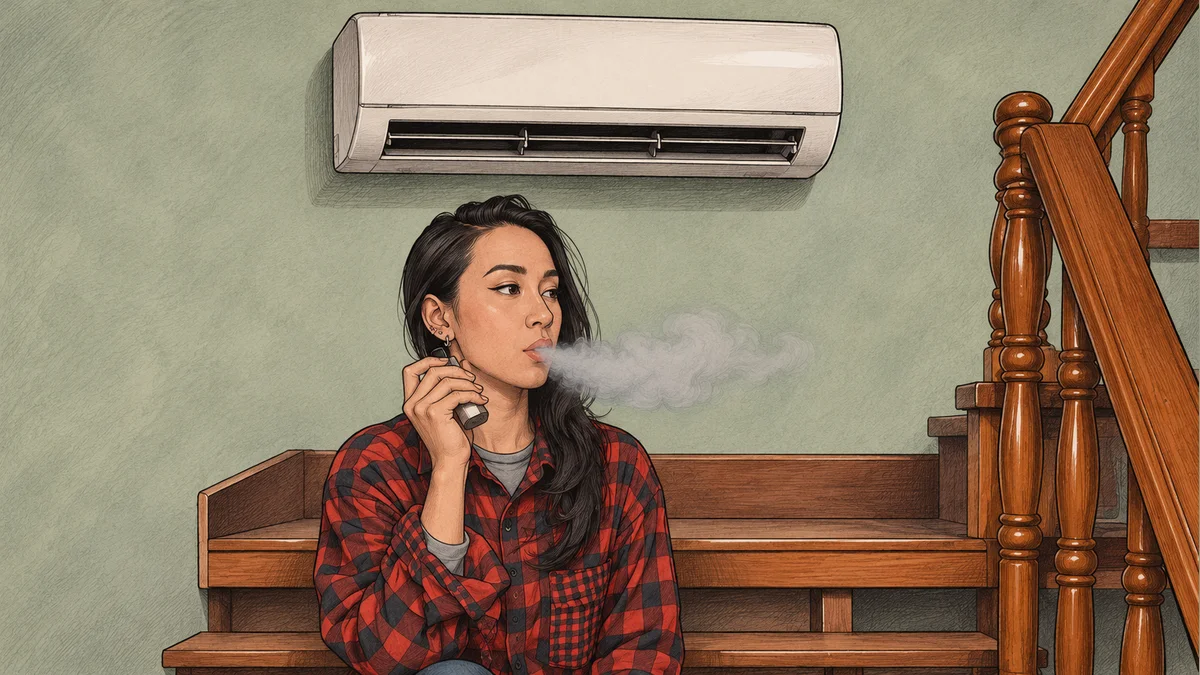
Picture yourself in an air-conditioned café. A friend beside you takes a puff on a vape, and a few seconds later the cloud disappears. Where did it go? Two questions matter here. How much air actually leaves the room? And who breathes that air before fresh air replaces it?
Where does exhaled vape aerosol go when the AC is on?
A typical split-system air conditioner draws air from the room, cools it and blows it back out through the indoor unit. The cool breeze on your face may be air that has been circulating in the room all along. Some buildings have a separate system that supplies outdoor air. The temperature on the remote tells you little about how quickly fresh air enters. [1]
A vape heats a liquid to produce an aerosol, a mixture of tiny particles or droplets suspended in air. When someone exhales it, other people can breathe it in. What it contains depends on the liquid and the device. Liquids containing nicotine can release it into the aerosol. The aerosol can also contain other substances, including formaldehyde and metals. [2]
What did researchers find in homes where people vape?
In a study across four European countries, researchers sampled the air for seven days in 29 homes where someone who vaped lived with someone who neither smoked nor vaped. They also sampled 21 homes where nobody smoked or vaped. [3]
The researchers detected airborne nicotine in 21 of the 29 homes where someone vaped, generally at low levels. In all 21 comparison homes, airborne nicotine was below the level the instruments could measure. Residents who did not vape but lived with someone who did also had higher levels of some markers of nicotine exposure in their saliva. You can be exposed without ever picking up a vape. [3]
One finding is easy to overlook. Average fine particle levels over the week were similar in the two groups of homes, even though the nicotine measurements differed. A reading on a household particle monitor alone cannot tell you whether your family has been exposed to nicotine. The study measured exposure over a week. It did not estimate the risk of illness from sitting beside someone who vapes on a single occasion. [3]
Does opening a window or using an air purifier help?
An open window can let outdoor air in, and an air purifier can remove some airborne particles. In an experiment with two connecting rooms, researchers found that closing the door lowered particle counts in the adjoining room but raised them in the room where vaping took place. Even the position of a door can affect who is exposed. [1] [4]
If you want to protect someone at the next table or a family member in the living room, the US Environmental Protection Agency (EPA) recommends keeping shared indoor spaces free of vaping. Ventilation and filtration can reduce exposure, but some substances can remain in the air. [2]
Can you vape in your bedroom, at work or in a café?
In Indonesia, Articles 442 and 443 of Government Regulation No. 28 of 2024 cover smoke-free areas, known locally as Kawasan Tanpa Rokok. The rules include e-cigarettes. What matters is how a place is used and whether it is designated smoke-free. Here is what that means in three everyday settings. [5]
- Your bedroom at home. Installing air conditioning does not automatically make a private bedroom a legally designated smoke-free area. If you share the room with a partner or child, keep it vape-free. [2] [5]
- A meeting room at work. Workplaces are among the smoke-free areas listed in the regulation. Under Article 443(5), a designated smoking area must be outdoors, separate from the main building and away from foot traffic and entrances or exits. Adding an exhaust fan to an enclosed meeting room does not meet those requirements. [5]
- A café dining area. Look for smoke-free signs, check local rules and follow the café’s policy. If you are unsure, put your vape away and ask the staff whether there is a designated area. A table beside a window or entrance does not automatically qualify. [5]
FAQFrequently asked questions
Can my child come back into the room as soon as the cloud disappears?
A cloud disappearing tells you little about what is still in the air. The household study did not establish a safe waiting time for a child to return. If children live in your home, keep bedrooms and shared living spaces vape-free at all times. [2] [3]
Can I use a vape labelled 0 mg nicotine in an office meeting room?
The 0 mg label refers to nicotine. Heating the liquid still produces an aerosol your colleagues can inhale. Indonesia’s smoke-free rules cover e-cigarettes, and Articles 442 and 443 provide no exemption based on the nicotine level on the label. [2] [5]
Can frequent vaping make an air conditioner dirty or damage it?
In a laboratory experiment, researchers found that nicotine from vape aerosol settled on glass and cotton fabric. The study did not test air filters, evaporator coils or the lifespan of an air conditioner. If your unit no longer cools the room well, a technician can inspect it and identify the cause. [6]

Kharisma Candra
Founder of Pipa Rokok Mascoro in Balung, Jember, Indonesia. He works with local craftspeople and writes about cigarette holders. About the author
Sources
- World Health Organization. How wall-mounted air conditioners and ventilation work.
- US Environmental Protection Agency. Secondhand electronic cigarette aerosol and indoor air quality.
- Amalia et al., Science of the Total Environment (2023). Household exposure to e-cigarette aerosol in four European countries.
- Zhang, Lin and Zhu (2020). Effects of ventilation, an adjoining door and air cleaning in two connected rooms.
- Government of the Republic of Indonesia. Government Regulation No. 28 of 2024, Articles 442 and 443 on smoke-free areas.
- Marcham et al. (2019). Nicotine from e-cigarette aerosol deposited on glass and cotton fabric.