
✦ Short answer
If you can’t trace the origin or contents of an e-liquid bought on an online marketplace, there’s no basis for saying it carries a lower risk than smoking a kretek through a cigarette holder. Research has found lower exposure to several toxic substances among people who exclusively vape. Those studies did not test the particular bottle an Indonesian buyer receives from an online seller.
- Kretek smoked through a holder. The cigarette still burns. Deposits often cling to the airway and build up, but their appearance doesn’t tell you how much of any substance enters the body.
- E-liquid from online marketplaces. In Indonesia, investigators have found e-liquids sold online by a maker who estimated the quantities in the mix. [2]
- The label and the bottle. Tests in Indonesia have found differences between the measured nicotine content and the strength stated on the packaging. [4]
Imagine looking at two bottles of e-liquid on an online marketplace. One carries a familiar brand name. The other is a locally mixed liquid with its own label. The photo shows the flavour, volume and stated nicotine strength. What it can’t show is who filled the bottle or whether they measured the ingredients as the label says. That’s where the question “Which is more dangerous, vaping or smoking a kretek through a holder?” gets more complicated.
Smoking a kretek through a holder and the vapes researchers studied
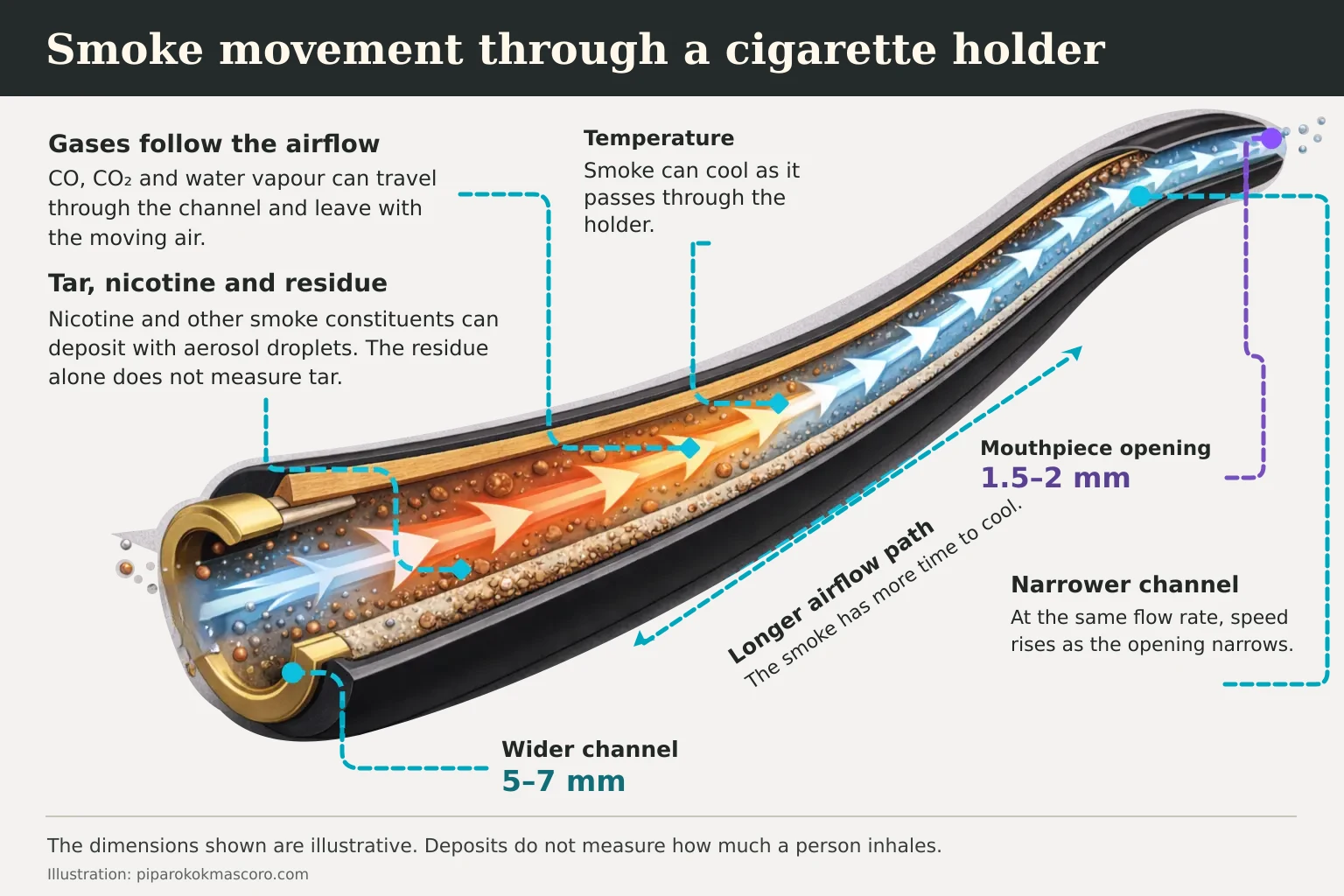
The pipe discussed here is a cigarette holder with a socket for a whole kretek, or clove cigarette. Once the cigarette is lit, smoke from combustion flows along the holder’s airway to the mouth. Some material can stick to the walls. The amount you see when cleaning the holder is not enough to calculate the smoker’s exposure.
A vape heats a liquid to produce an aerosol that the user inhales. In a US study involving 5,105 adults, researchers measured markers of exposure in urine. People who exclusively vaped generally had lower levels of several markers of toxic substances than people who exclusively smoked. Levels of some metals were comparable. These findings describe differences in exposure between groups. They cannot quantify the difference in long-term disease risk between smoking kretek through a holder and using a particular Indonesian brand of e-liquid. [1]
What has been found on the Indonesian market?
14,338 bottles ready for sale from a producer selling online
On 10 September 2021, Sidoarjo Customs traced an online seller to a production site and warehouse in Surabaya. Officers seized 14,338 bottles of e-liquid ready for sale without excise stamps. At a press conference that November, the person who mixed the liquid said he had estimated the quantities. That poses a practical problem for buyers. Before ordering, how could anyone tell from a photo how the seller measured the ingredients? [2]
Convincing packaging can conceal a problem with the contents
In October 2019, Jakarta Metropolitan Police reported a case involving online sales of e-liquid containing drugs. The 100 ml bottles bore stamps that looked official at first glance. Police confirmed that the excise stamps were fake and had been put there to mislead buyers. The case shows why a resemblance to official packaging is insufficient to establish authenticity. [3]
Nicotine strengths on labels have also been inaccurate
In July 2024, Bambang Prasetya, a researcher at Indonesia’s National Research and Innovation Agency (BRIN), presented test results for e-liquids circulating in Indonesia. On average, measured nicotine levels were lower than the label claims. Some samples contained around half the stated amount or even less. For someone choosing an e-liquid by nicotine strength, the number they base their purchase on can therefore be inaccurate. [4]
What substances did Indonesia’s National Narcotics Agency find in e-liquids?
On 30 October 2026, the National Narcotics Agency (BNN) reported laboratory results for 341 samples of e-liquid. Thirty-five samples contained narcotics or dangerous psychoactive substances. The breakdown is shown below. [5]
| Substance detected | Number of samples |
|---|---|
| Etomidate | 23 |
| Synthetic cannabinoids | 11 |
| Methamphetamine | 1 |
What do a business licence, an excise stamp and a test result tell you?
In Indonesia, producers and importers of electronic cigarettes must have a business licence, have the nicotine level of each variant tested by an accredited laboratory, and report test results, ingredients and additives. Regulations issued by the Indonesian Food and Drug Authority (BPOM) also require a certificate of analysis for each ingredient reported. The reporting requirements apply to new variants and when ingredients or the name of the producer or importer change. [6] [7]
If a seller says an e-liquid “has BPOM approval,” what exactly do they mean? BPOM’s Pekanbaru office explains that BPOM supervises electronic cigarettes on the market, while registering marketing authorisations for these products falls outside its remit. A genuine excise stamp shows that excise duty has been paid. To assess a claim about ingredients, you need the producer’s identity, the variant tested and test results that actually apply to that product. Even when a nicotine test matches the label, risks from other substances still need to be assessed separately. [7] [8] [9]
Which poses more risk to a buyer?
In the groups studied, people who exclusively vaped nicotine were generally exposed to lower levels of several toxic substances than people who smoked combustible cigarettes. Now consider a bottle of e-liquid from an Indonesian marketplace whose maker and ingredients cannot be traced. We have no basis for assuring the buyer that inhaling aerosol from that liquid carries a lower risk than smoking a kretek through a holder. [1] [2] [5]
That applies both to a small business’s own blend and to a bottle designed to look like a famous brand. The same question is worth asking of both. Who made it, and what evidence shows that the liquid delivered to the buyer matches the label?
FAQFrequently asked questions
Is e-liquid from a small producer automatically more dangerous?
The size of the business alone can’t answer that. You need to know who makes it, how they control the quantities and whether the ingredient information and test results can be traced to the particular variant for sale.
Does 35 out of 341 mean that around one in ten bottles on a marketplace contains narcotics?
That figure applies to the samples BNN reported. Estimating a buyer’s chances of receiving such a bottle would require a survey representative of the products and sellers on Indonesian marketplaces.
Were the 14,338 bottles seized in Surabaya shown to contain etomidate?
The Surabaya report documented sales without excise stamps and the maker’s account of estimating quantities. The etomidate finding came from separate tests that BNN announced in October 2026.

Kharisma Candra
Founder of Pipa Rokok Mascoro in Balung, Jember. Kharisma works with local craftspeople and writes about cigarette holders. About me (in Indonesian)
Sources
- Goniewicz et al., JAMA Network Open (2018). Comparison of exposure among people who use e-cigarettes, combustible cigarettes or both.
- Suara Surabaya (2 November 2021). Sidoarjo Customs action against an e-liquid producer selling online.
- detikNews (28 October 2019). Jakarta Metropolitan Police statement on fake excise stamps on e-liquid bottles.
- ANTARA (3 July 2024). BRIN researcher’s presentation on differences between measured and labelled nicotine levels.
- Indonesian National Narcotics Agency (30 October 2026). Laboratory results for 341 electronic cigarette liquid samples.
- Government of the Republic of Indonesia. Government Regulation No. 28 of 2024, Article 431(5) and (7).
- Indonesian Food and Drug Authority. BPOM Regulation No. 18 of 2025, particularly Articles 16–17.
- BPOM Regional Office in Pekanbaru. Explanation of electronic cigarette registration and market oversight, third-quarter 2025 service report, pp. 10–11.
- Indonesian Directorate General of Customs and Excise. The purpose of excise stamps.